 |
| Gas odorant spills and fires |
| National Grid uses an odorant called mercaptan to make natural gas smell like sulfur or rotten eggs. While non‑hazardous at the very low concentrations present in natural gas pipelines, spills of concentrated mercaptan liquids are considered both hazardous and flammable. Learn how to protect yourself and the public when responding to mercaptan spills and fires. |
|
|
| Wear PPE and SCBA for any mercaptan spill |
| The mercaptan compound typically used within National Grid’s service territory is a mixed mercaptan, predominantly Tertiary Butyl Mercaptan (TBM). National Grid stores TBM in liquid and gas form in tanks at processing plants, metering stations and regulating stations. |
| Exposure to concentrated TBM liquids can cause significant skin, eye and respiratory irritation as well as drowsiness and dizziness. Liver and circulatory system damage can occur with prolonged or repeated exposures. |
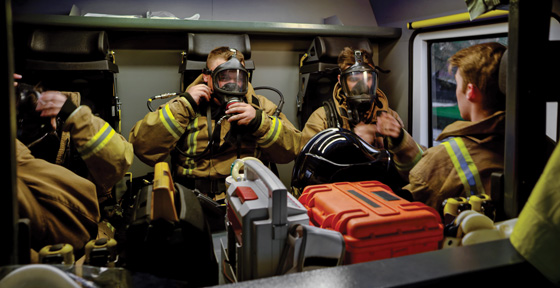
| When responding to a TBM release, implement a hazardous materials response and follow all internal procedures. Wear chemical‑resistant personal protective equipment (PPE) and self‑contained breathing apparatus (SCBA) in the presence of any TBM spill or leak, whether large or small. |
 |
|
| Use ERG Guide 131 for isolation and evacuation |
| Follow these precautions from Guide 131 of the Emergency Response Guidebook (ERG): |
| • |
 |
Isolate the mercaptan spill area for at least 50 meters (150 feet) in all directions and keep out the public and non‑essential personnel. Increase this distance in the downwind direction, as necessary. |
|
| • |
|
For a large spill, consider initial downwind evacuation for at least 1,000 feet. |
|
|
| • |
|
If a tank, rail car or tank truck carrying TBM is involved in a fire, isolate and consider initial evacuation for 800 meters (one‑half mile) in all directions. |
|
|
| Prevent ignition |
| TBM has high vapor pressure, meaning it readily forms flammable vapors even at room temperature. These vapors are heavier than air. They tend to sink and collect in low‑lying areas and confined spaces, where they can accumulate to form explosive concentrations. |
| Eliminate all ignition sources (flames, sparks and sources of static electricity) in the vicinity of TBM vapors or liquid. Use intrinsically safe (non‑sparking) radios and flashlights for the duration of the incident response. |
| Control flames; cool containers |
| If TBM ignites, position apparatus and personnel at least 150 feet away and upwind to avoid toxic vapors and radiant heat. Use alcohol‑resistant foam, carbon dioxide (CO2) or dry chemical to extinguish the flames. Do not use a high‑volume water jet on a mercaptan fire. |
| You may use a water spray to cool fully closed containers. If it can be done safely, move undamaged containers away from the area around the fire. |
| Protect waterways |
| Mercaptan has highly toxic and long‑lasting effects on aquatic life. Do not disperse the spill with water and do not allow runoff from the spill or firefighting activities to enter drains, soil or waterways. Instead, block off nearby storm drains and sewers. Absorb the spill with sand, earth or another non‑combustible medium and collect it for disposal by a licensed waste management company. If mercaptan does contaminate waterways, inform the proper authorities. |
| Keep yourself, your team and the public safe this winter and year‑round. Visit firstresponder.ngridsafety.com today to register and complete your FREE utility safety training. |
|
|
|
|
| |
To report emergencies, call 911 and National Grid immediately.
Always call 911 if you suspect a gas leak! |
| |
|
To report emergencies, call 911 and National Grid immediately.
Always call 911 if you suspect a gas leak! |
 |
| In case of gas emergencies: |
|
Long Island and the Rockaways:
911 and 1‑800‑490‑0045 |
|
Metro New York:
911 and 1‑718‑643‑4050 |
|
Upstate New York:
911 and 1‑800‑892‑2345 |
|
Massachusetts:
911 and 1‑800‑233‑5325 |
|
|
|
|
| |
|
|
|
| |
| |
|
|
#17664 © 2026 Culver Company, LLC |
|
| |
|
|
|
|
|
|