 |
| Oil releases from electrical equipment |
|
Transformers and other electrical equipment may release oils if they are damaged by impact or fire. These oils not only contain toxic substances but can also pose explosion risks. Learn how to protect yourself, the public and the environment when responding to oil release incidents. |
|
|
 |
|
| Take initial precautions |
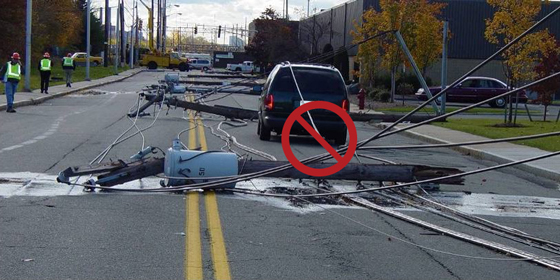
| Oil releases may originate from transformers, voltage regulators, capacitors, switchgear, reclosers and other electrical equipment on utility poles and in substations. |
| Report any oil release to the incident commander and National Grid immediately. Utility personnel must de‑energize electrical equipment before spill mitigation or firefighting can occur safely. |
| While you wait for National Grid personnel to arrive, take these precautions: |
| • |
 |
Wear proper personal protective equipment and self‑contained breathing apparatus to prevent exposure to potential contaminants. |
|
| • |
|
Isolate the area and keep unauthorized personnel and the public away. |
|
| ⚬ |
|
For oil releases from ground- or pole‑mounted transformers, maintain a 50‑foot perimeter. |
|
| ⚬ |
|
If the oil release is from electric substation equipment, isolate at least 300 feet in all directions. |
|
|
| • |
|
If oil or oil‑filled equipment is burning, stay upwind and consider initial downwind evacuation for at least 1,000 feet. This distance may need to be extended based on weather conditions and incident size. |
|
|
| Prevent oil spread and water contamination |
| Follow standard tactics for hazardous chemical releases. Treat any oil release from electrical equipment (whether to air, water or soil) as a hazardous materials incident. Note: Hazardous materials will be handled and disposed of by National Grid or an authorized contractor. The National Grid representative who arrives on site will coordinate and facilitate the process. |
| Do not spread the oil. Do not walk through an oil spill, and do not drag hoses or drive vehicles through it. After National Grid confirms the involved equipment is de‑energized, use absorbent and containment materials to prevent the oil from spreading. |
| Prevent contamination of water resources. Limit or direct water spray to prevent migration of transformer oil to manholes, wetlands, catch basins and bodies of water. Do not use water to wash spilled oil into catch basins. |
| Stay alert for PCBs |
| Be alert to the possibility that transformer oil may contain polychlorinated biphenyls (PCBs). |
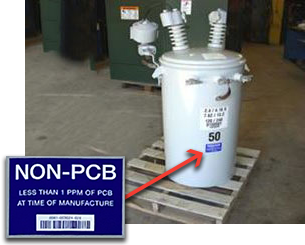
| PCBs are considered a probable carcinogen. They were widely used as a cooling oil in electric capacitors and transformers until 1979, when the U.S. Environmental Protection Agency banned them for most uses. Most National Grid equipment is non‑PCB, as shown on this blue label. |
|
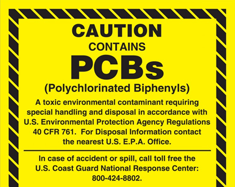
| In rare instances, you may see a yellow PCB warning label, which is required on certain types of equipment containing PCBs at concentrations of 500 ppm or greater and at entrances to areas where such equipment exists. This warning label alerts you to the presence of PCBs, but PCBs may be present even if you do not see this label. The label may not be required due to the level of PCBs present or the equipment types. |
|
| Whether or not you see a warning label, assume that all oil releases from electrical equipment are PCB‑contaminated. Take the precautions above, as well as any additional, specific safety measures based on your departmental training, and follow decontamination procedures for personnel and equipment. |
| Firefighting tactics |
| Protect area exposures per the 30/30/100 rule: stay 30 feet away from energized objects and use a 30‑degree fog pattern at 100 psi. Stay alert for toxic smoke and explosion hazards. |
|
|
| • |
|
If released oil is burning, you may extinguish the fire with protein foam sprays and water fog streams. NEVER use a solid stream of water on oil, as it can spread the fire. |
| • |
|
If oil‑filled electrical equipment is burning, let it burn itself out. The equipment is already ruined and cannot be saved. Do not attempt to extinguish the fire unless directed by the utility and your incident commander. |
|
| Once the fire is out, be aware that nearby power lines may still be energized. |
|
| Keep yourself, your team and the public safe this fall and year‑round. Visit firstresponder.ngridsafety.com today to register and complete your FREE utility safety training. |
|
|
|
| |
To report emergencies, call 911 and National Grid immediately.
Always call 911 if you suspect a gas leak! |
| |
|
To report emergencies, call 911 and National Grid immediately.
Always call 911 if you suspect a gas leak! |
 |
| In case of gas emergencies: |
|
Long Island and the Rockaways:
911 and 1‑800‑490‑0045 |
|
Metro New York:
911 and 1‑718‑643‑4050 |
|
Upstate New York:
911 and 1‑800‑892‑2345 |
|
Massachusetts:
911 and 1‑800‑233‑5325 |
|
|
|
|
| |
|
|
|
| |
| |
|
|
#17661 © 2025 Culver Company, LLC |
|
| |
|
|
|
|
|
| |